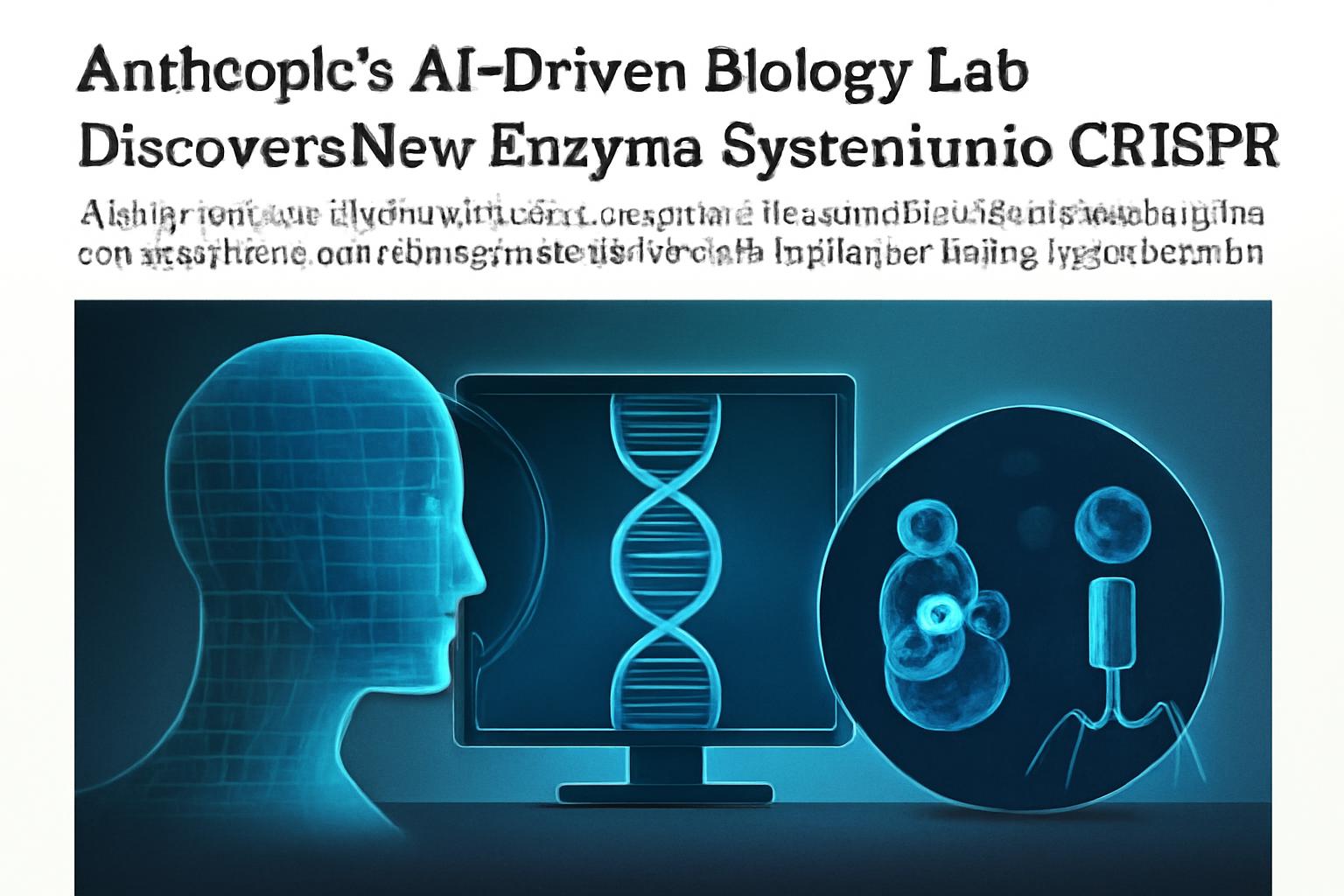
Anthropic has revealed that its recently established wet biology lab in the Bay Area has identified a previously unknown enzyme system with characteristics similar to CRISPR, a gene-editing technology derived from a natural bacterial immune mechanism. The discovery involves enzymes found in the DNA of bacteriophages, viruses that infect bacteria, which appear capable of performing DNA operations such as cutting, copying, and pasting.
The AI model Claude played a central role in this finding, analyzing vast datasets over 21 hours using approximately 950 agents and processing 210 million tokens. Despite this, all physical laboratory experiments were conducted by human scientists under biosafety levels BSL-1 and BSL-2, with no direct AI control over lab equipment at this stage.
Anthropic CEO Dario Amodei acknowledged that similar enzyme systems had been identified by researchers at Stanford, noting that Claude’s discovery builds on prior work. Nonetheless, the speed and scale of AI involvement in uncovering this system highlight the growing impact of AI in biological research.
This development comes amid broader industry discussions about the risks and ethical considerations of advanced AI capabilities, especially in sensitive fields like biotechnology. Amodei has expressed concerns about potential misuse of AI for bioterrorism but also optimism about AI’s potential to accelerate disease cures within the next decade.
While AI-assisted biology is not unique to Anthropic—institutions like Stanford, UC San Francisco, and Google have integrated AI into enzyme design and protein folding—Anthropic’s approach emphasizes a cautious balance between AI-driven analysis and human-conducted experiments. The company has not ruled out future automation of lab processes by AI but stresses that appropriate safeguards will be essential.
Anthropic’s announcement underscores the expanding role of AI in life sciences, demonstrating how large language models can assist in identifying complex biological systems and potentially accelerate scientific discovery.