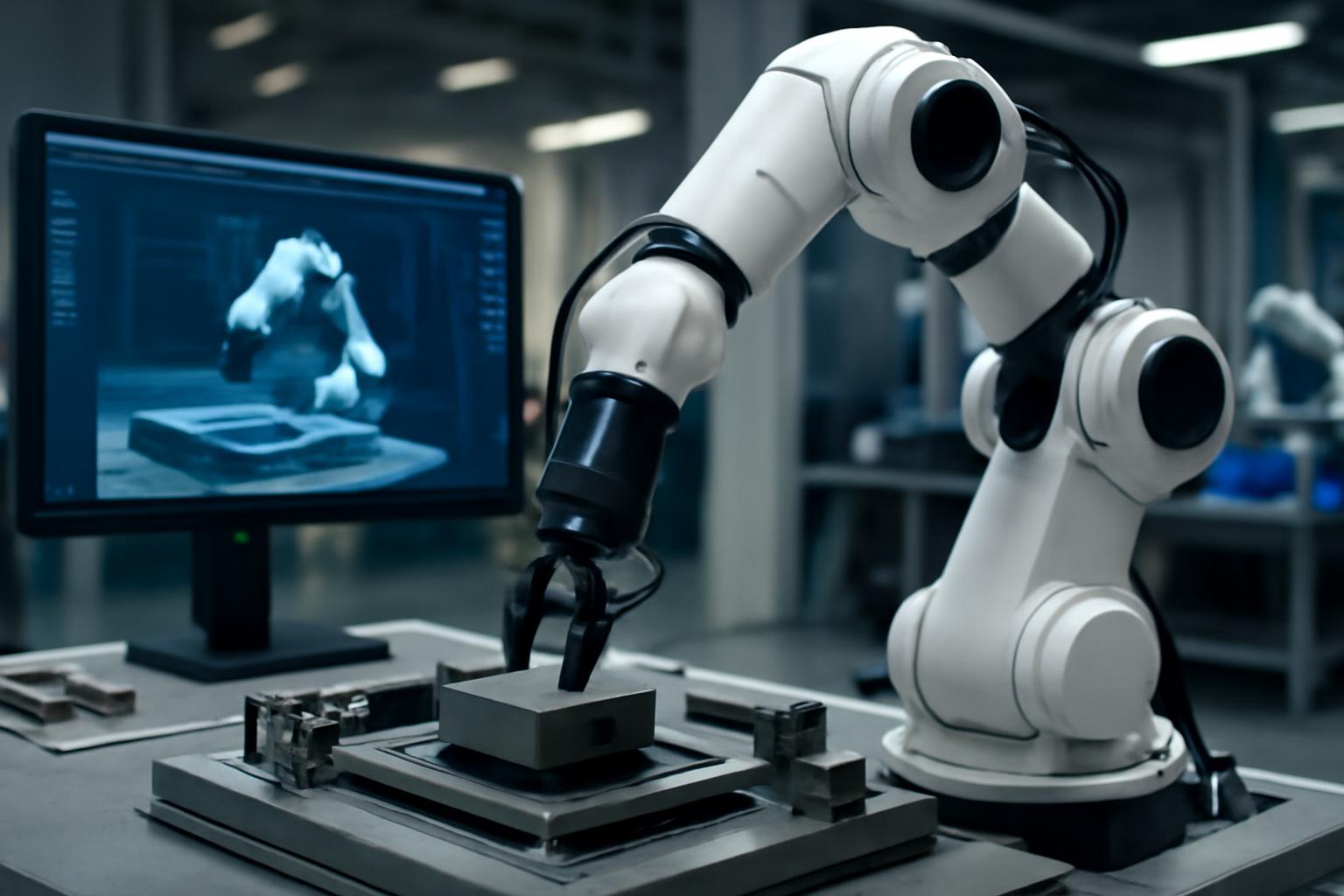
Industrial Next, a San Francisco-based startup, is introducing AI-powered robotic stations designed to drastically reduce the time required to switch manufacturing tasks. Unlike traditional factory robots programmed for single, repetitive jobs, Industrial Next’s robots leverage proprietary foundation models that integrate vision, task context, and motion to enable retooling in minutes rather than weeks.
The company presented its technology at TechCrunch Disrupt 2026 and announced a partnership with BMW Group Technology Office to evaluate its AI-driven dexterous manipulation capabilities for manufacturing applications. Founded in 2021 by Lukas Pankau and Allen Pan, both former Tesla engineers, Industrial Next aims to address the limitations of legacy factory equipment that hinder automation flexibility.
Pankau and Pan conceived the startup after experiencing firsthand the challenges of programming robots for complex tasks during their time at Tesla. They observed a disconnect between advanced vehicle design and the outdated industrial machinery used for production. Their solution uses detailed simulation environments to train robots on high-precision tasks without relying on extensive real-world data, which is scarce in robotics compared to internet-based AI training.
Industrial Next’s robotic stations are modular and can be reconfigured or redeployed across different product lines. New tasks are taught through simulation and demonstration rather than traditional hard-coded programming. The startup already has deployments in smartphone manufacturing, automating delicate processes like threading flex cables and removing protective films with human-level speed and accuracy.
The founders envision expanding their technology to automate more complex manufacturing processes, including complete vehicle assembly without human intervention. This approach could reduce costly downtime and enable manufacturers to produce more varied and intricate products without extensive retooling.
Industrial Next’s advancements highlight a growing trend toward flexible, AI-driven automation in manufacturing, potentially reshaping how factories adapt to changing production demands.