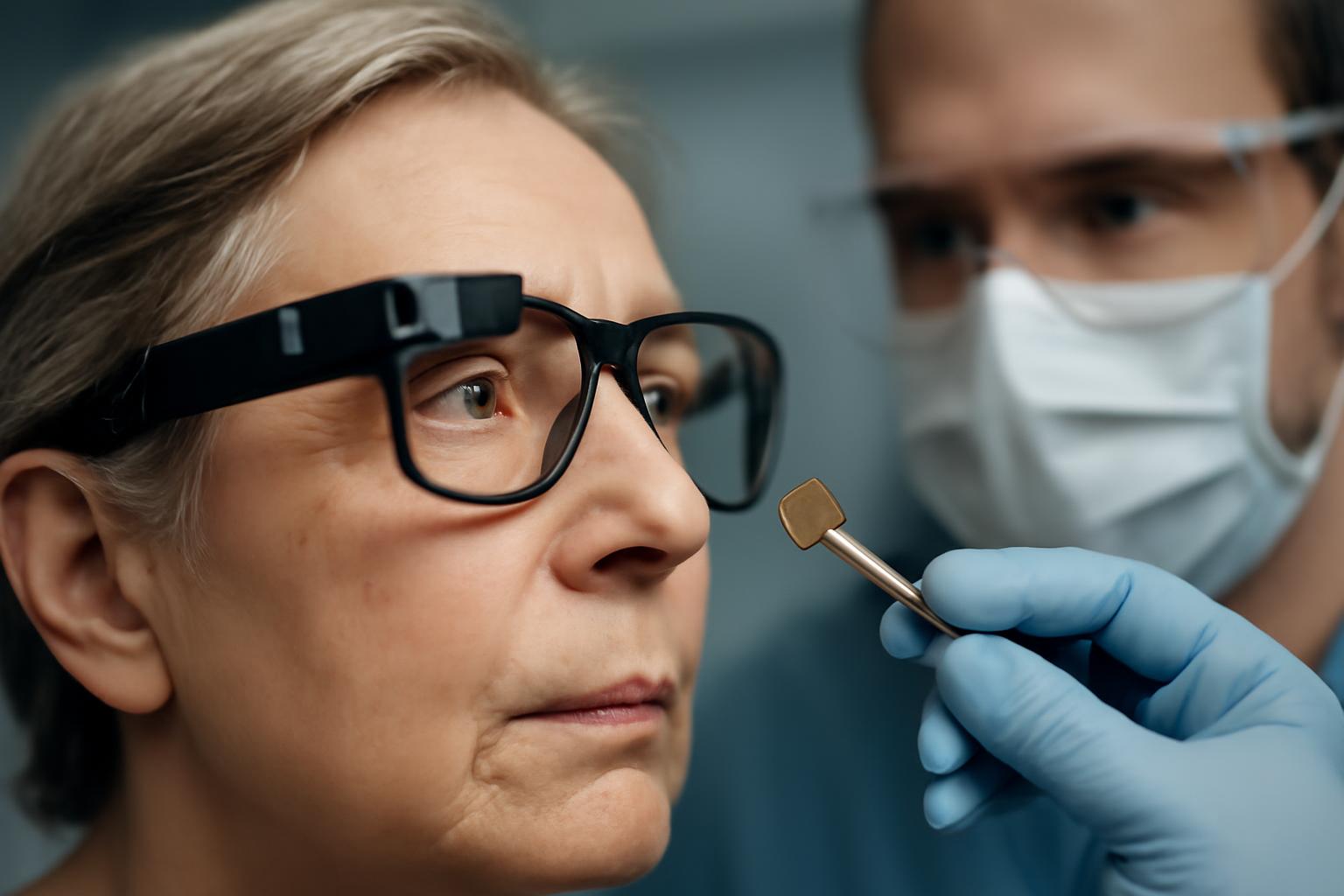
Science Corporation has successfully implanted its PRIMA vision-restoring chip into its first patient diagnosed with Stargardt disease, an inherited condition that progressively impairs central vision. The announcement was made by CEO Max Hodak, former Neuralink president and co-founder, during TechCrunch Disrupt, where he also discussed the company’s broader ambitions in brain-computer interface (BCI) technology.
Stargardt disease causes degeneration of photoreceptor cells in the outer retina, leading to a growing central blind spot while often preserving the inner retina, which transmits visual signals to the brain. Approximately 150,000 people worldwide suffer vision loss from this currently incurable disease. PRIMA, already commercially available in Europe for geographic atrophy patients, functions as an artificial photoreceptor by converting visual information captured via camera-equipped glasses into electrical signals sent to the brain.
The implant procedure involves placing a small, 2x2 millimeter chip at the back of the eye where photoreceptors have deteriorated. During early rehabilitation, the first patient was able to recognize letters and read words, demonstrating the device’s potential to restore functional vision. Hodak described the current implant as providing a sharp, high-contrast black-and-white central vision “patch” with a limited field of view, akin to looking through a straw.
Science Corporation aims to enhance the device’s resolution and expand its field of view by developing smaller electrodes and larger implants that conform to the eye’s curvature. Hodak anticipates a next-generation implant suitable for human trials within a year and expects to approach near-native visual acuity within five years.
Beyond vision restoration, Science Corporation is advancing BCI technology with plans to implant sensors on the brain’s surface rather than penetrating brain tissue, differentiating its approach from Neuralink’s. The company envisions applications in neurological monitoring and treatment, including neurodegenerative diseases and stroke rehabilitation, by potentially creating new cortical connections.
Hodak emphasized the company’s long-term mission to understand brain function and develop engineered brains, predicting widespread BCI adoption in older populations to extend both lifespan and health span. Science Corporation continues to focus initially on demonstrating clinical efficacy and building a sustainable business through vision restoration before expanding into broader neural engineering applications.