Justin Fanelli, the Department of Navy’s chief technology officer, has emphasized ongoing efforts to streamline the Navy’s technology procurement and better integrate commercial innovation. Over the past few years, Fanelli has worked to simplify the Navy’s engagement with startups and technology firms, shifting from a complex, multi-entry system to a more focused funnel that pulls in companies demonstrating strong results.
This year, Fanelli shared an updated list of the Navy’s technology priorities, developed in collaboration with the Portfolio Acquisition Executive for Mission Systems and vetted by venture investors. The goal is to provide clearer guidance to companies and investors about the Navy’s future buying plans, encouraging private capital to take on early-stage technology development.
Fanelli noted that while the Navy’s total annual spending is around $150 billion, much of that flows through traditional contracts. The Navy is increasingly pursuing co-investment strategies, partnering with private investors and purchasing from later-stage companies, typically in Series D to F funding rounds. This approach reduces the Navy’s role in early research, relying instead on commercial investors to mature technologies.
Recent Navy acquisitions illustrate this shift. Contracts include a $562 million deal for the MQ-25 Stingray autonomous refueling drone and purchases of edge computing hardware from Armada for deployment on ships. The Navy has also adopted inspection robots from Gecko Robotics and machine learning pipelines managed by Domino Data Lab. Notably, the Navy replaced a delayed shipboard camera system from a defense contractor with commercial cameras and software from Applied Intuition, accelerating deployment by four years.
Fanelli described the Navy’s procurement process as streamlined, with purchase decisions made by small source selection committees to maintain merit-based evaluations. He also highlighted that technology adoption often depends on budget cycles and the ability to replace existing systems.
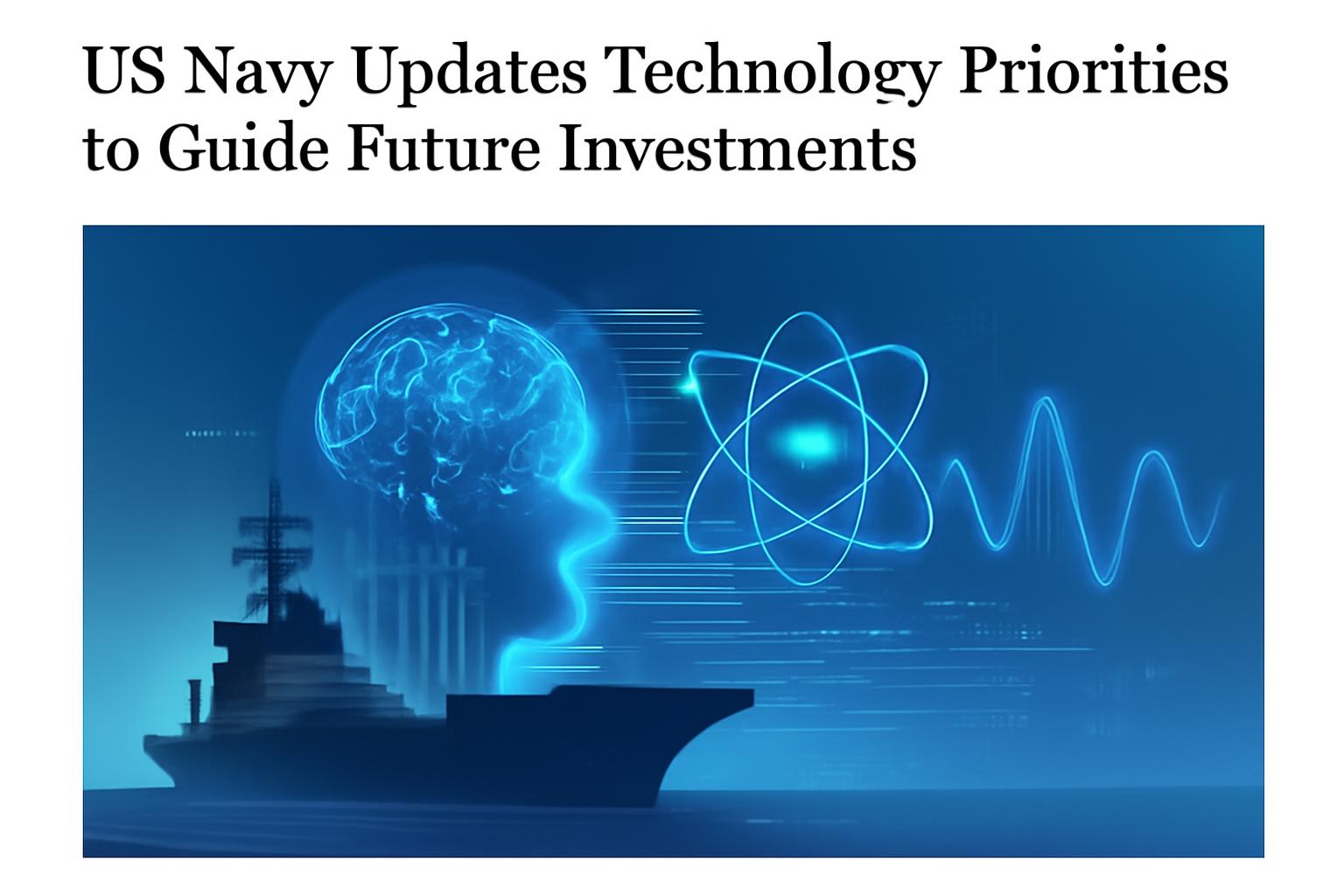
The updated technology priorities fall into five main categories: applied artificial intelligence, focusing on machine learning and autonomous decision-making; quantum information science, emphasizing applications in navigation and secure communications; advanced networking, aimed at secure data transfer in challenging environments; electromagnetic spectrum operations, designed for adaptive spectrum management; and digital engineering and interoperability, which includes open APIs and zero-trust architectures to enable seamless system integration.
While the list does not represent funding commitments or rank specific programs, it serves as a strategic roadmap for industry and investors to align their development efforts with the Navy’s evolving needs. Fanelli stressed that these priorities will adapt based on emerging threats and operational requirements.